There are many places water is held around the world. Water goes through the water cycle and ends up in oceans, rivers, lakes, etc. It freezes at the poles and creates icebergs. Well, water is also held underground. How does it get there? Gravity of course! Gravity pulls the water downward, and it seeps into the ground.
Groundwater is water that is held underground. Makes sense, right? Well, the spots where the water is held underground are called aquifers. Specifically, they are underground layers of permeable rock that contains water. Now, what does “permeable” mean, you ask? Well, it means that liquids are able to pass through that substance. For example, gravel or sand. The opposite of that is impermeable, which means that liquids cannot pass through it. And the impermeable spots in the ground are called aquitards.
Now, there are different areas in the ground. The first is the unsaturated zone. This zone of the ground, as the name implies, isn’t saturated with water. The layer below that is called the saturated zone. This is the zone with the aquifers and, as the name also implies, it is saturated with water. Note that an aquifer is not an underground lake or river. It is only water between the gaps between rocks.
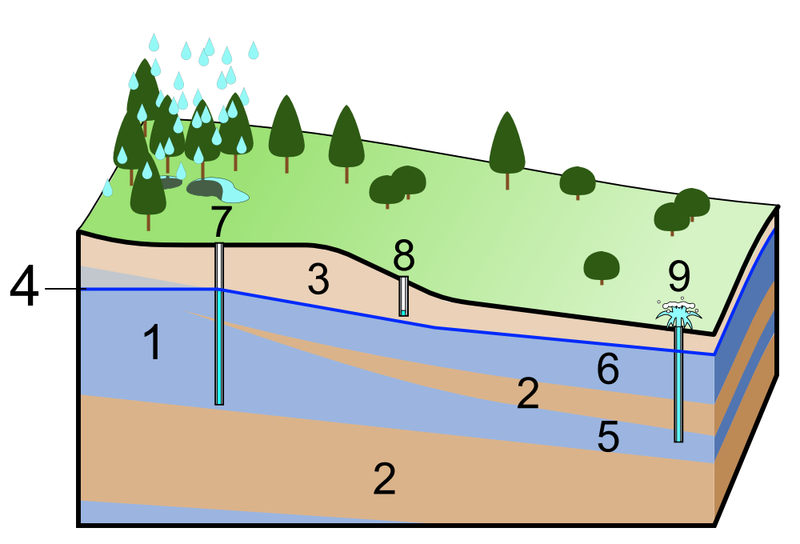
Shigeru23, Wikimedia Commons, CC-BY-SA-3.0
The top of the saturated zone is called the water table. If the top of the ground dips below the water table, it makes a spring. An example of a spring is a river or a lake.
Picture Labels
1. Aquifer
2. Aquitard
3. Unsaturated zone
4. Water table
5. Confined aquifer
6. Unconfined aquifer
7. Deep well
8. Sort well
9. Artesian well
*unfinished, sorry*