

Mc681, Wikimedia Commons, CC-BY-SA-4.0
I coded this calculator myself! Let me know what you think!
Calculator
Addition
Subtraction
Multiplication
Mc681, Wikimedia Commons, CC-BY-SA-4.0
I coded this calculator myself! Let me know what you think!
There are many places water is held around the world. Water goes through the water cycle and ends up in oceans, rivers, lakes, etc. It freezes at the poles and creates icebergs. Well, water is also held underground. How does it get there? Gravity of course! Gravity pulls the water downward, and it seeps into the ground.
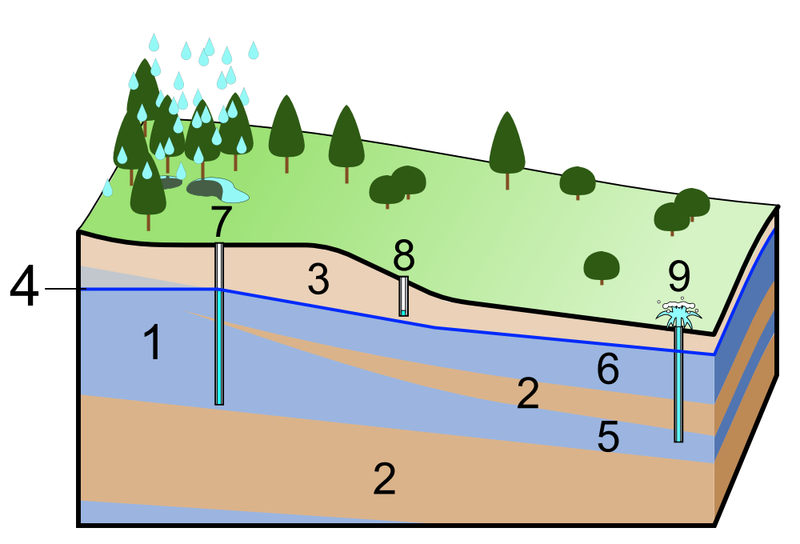
Groundwater is water that is held underground. Makes sense, right? Well, the spots where the water is held underground are called aquifers. Specifically, they are underground layers of permeable rock that contains water. Now, what does “permeable” mean, you ask? Well, it means that liquids are able to pass through that substance. For example, gravel or sand. The opposite of that is impermeable, which means that liquids cannot pass through it. And the impermeable spots in the ground are called aquitards.
Now, there are different areas in the ground. The first is the unsaturated zone. This zone of the ground, as the name implies, isn’t saturated with water. The layer below that is called the saturated zone. This is the zone with the aquifers and, as the name also implies, it is saturated with water. Note that an aquifer is not an underground lake or river. It is only water between the gaps between rocks.
Shigeru23, Wikimedia Commons, CC-BY-SA-3.0
The top of the saturated zone is called the water table. If the top of the ground dips below the water table, it makes a spring. An example of a spring is a river or a lake.
Picture Labels
1. Aquifer
2. Aquitard
3. Unsaturated zone
4. Water table
5. Confined aquifer
6. Unconfined aquifer
7. Deep well
8. Sort well
9. Artesian well
*unfinished, sorry*
National Gallery of Art, Wikimedia Commons, CC0-1.0
The Civil War in the United States lasted from April 12, 1861, to April 9, 1865. It began with antsy Southern states concerned about presidential elections. Abraham Lincoln was running in these elections and was very publicly against slavery. However, the South was prominently a slave-holding place, as they used slaves to help them with farming. Because of this, many Southern states didn’t allow Lincoln’s name on their ballot.
However, the Democratic Party was split over the topic of slavery. They divided into three parties: the Southern Democratic Party, whose candidate was John C. Breckenridge; the Constitutional Union Party, whose candidate was John Bell; and the Democratic Party, whose candidate was Stephen A. Douglass. The Republican Party chose Abraham Lincoln to represent them. Because the votes now had to split 4 ways, it didn’t matter that many Southern states didn’t let him on their ballot; Lincoln ended up winning anyways.
If Lincoln were elected, many Southern states feared that he would abolish slavery and entirely change their livelihoods. So, before Lincoln’s inauguration, 7 states seceded and formed the Confederate States of America. Afterward, 4 more joined them. In order, the states that seceded were:
…he looked so grieved that I feared some evil had befallen our family. After a few minutes’ painful silence, he told me, as a man might speak of a sentence of death.
– Varina Davis, Jefferson Davis’s wife
The president elected for the Confederacy was Jefferson Davis. The quote above is a description by his wife of when he got the message. So, Davis didn’t really want to be elected President, but soon thereafter he sent a letter of acceptance back and later moved to the new Confederate capital in Richmond, Virginia.
The first battle of the war (or a cause, it’s debatable) was Fort Sumter. It was a fort in South Carolina held by American/Union troops. Before, when SC was part of the USA, they were fine with them there. But now that they had seceded, they wanted those soldiers off their land! Confederate General Beauregard demanded the surrender of the fort, but Union Major Anderson refused. Soon, there was firing upon Fort Sumter, and within 34 hours the fort was finally surrendered. Fun fact: the only casualty of the battle was a Confederate horse! Another fun fact: Anderson was Beauregard’s teacher at military training; here the student turns on the teacher!
War preparations began soon afterward. Civilians signed up on both sides; so many that both sides had to turn away some! In the North, there was a group called the “Elite 7th” who took sandwiches and velvet stools to war with them. This was because they thought that the war would be easy, fair, fun, and quick. However, William T. Sherman disagreed. According to him,
You politicians have got things in a hell of a fix, and you may get them out as best you can. I will have no more to do with it.
– William T. Sherman
Sherman believed it was a politician’s war and that he wasn’t involved, so he resigned. However, when Sumter fell, Sherman reluctantly put his uniform back on to fight. But he predicted that it would be a more prolonged war than the politicians expected.
In the Union, General Robert E. Lee was the first pick for the leader of their army. But, Lee was loyal to Virginia. And since it had seceded, he resigned and joined the Confederacy as the leader of the Confederate army. Ulysses S. Grant was the Union’s second pick, and at the beginning of the war, he worked in the mustering office, handling volunteers.
There were many causes of the Civil War. Included were the Northwest Ordinance, the Missouri Compromise, Nat Turner’s Rebellion, the Compromise of 1850, the publication of Uncle Tom’s Cabin, the Kansas-Nebraska Act, the Dred Scott case, John Brown’s raid on Harpers Ferry, and Lincoln’s Election.
The Northwest Ordinance was a law that banned slavery North and West of the Ohio River. This upset people who owned slaves in that area.
[…]
The war ended after the Battle of Appomattox when General Lee’s armies were completely shattered and he was on the run. He became surrounded by the Union soldiers, and the only thing he could do was surrender. Lee stated how he would rather die a thousand deaths than go see General Grant. He sent a letter with a white flag to the Union soldiers, who then went to pass on the message to Grant. When the letter arrived, Grant had a blinding headache. He asked one of his commanders to read the letter aloud. After hearing the letter, his headache went away. When the Union soldiers heard about the surrender, they began to weakly cheer or cry, as they were too tired to do otherwise.
The place where the terms of surrender were to be written was the house of Wilmer McLean. This is significant because he previously lived in the area where the Battle of Bull Run took place, and his house was used there by soldiers, too. Afterward, he moved away, trying to get away from the war. But the war caught up with him.
The first to arrive at the house was General Lee. He was dressed formally and brought a fancy sword. He told an aid that it was because he believed he was going to become General Grant’s prisoner, and he wished to look his best for it. Half an hour later, General Grant arrived. He was not dressed up like Lee because he just came from the field, and he apologized for it. On the day of the surrender, Grant was feeling sad and depressed. Not wanting to start writing the surrender yet, Grant mentioned to Lee that they had met previously; during the Mexican war, Grant served Lee. Lee didn’t remember that, but he reminded Grant why they had come together in the first place.
The terms of the surrender were written by the young soldier Eli S. Parker. While trying to write the terms out, his hand shook violently from being in the presence of the two mighty generals, and at one point the pen had to be taken by an older soldier. The terms were that horses and sidearms can be kept; horses for the upcoming planting season, and sidearms for defense. Food was also to be given to the Confederate soldiers, as Grant knew they were starving because of the pillaging of the Union’s food supplies. When Lee left the McLean house, the Union soldiers began to cheer, to really cheer this time. But Grant stopped them. The Confederates were going to be part of the USA again, so they were no longer against them.
When Lee returned to the Confederate camp, he couldn’t look the soldiers in the eyes. His head hung as he sadly rode Traveler (his horse) into the camp. As he passed, the soldiers sadly said goodbye or passed their hands over Traveler.
*unfinished, sorry*